

How Multiple Buyer Apps Access the Same Sellers on ONDC (Network Effect Explained Simply)
Learn how ONDC connects multiple buyer apps to the same sellers through the Beckn Protocol, enabling seamless discovery, orders, payments, and delivery across the network.
.png)
Quick Answer
Multiple ONDC buyer apps can access the same sellers because every app on the network — buyer app, seller app, and logistics provider — speaks the same open language, called the Beckn Protocol. It works like email: a Gmail user can message a Yahoo user without either company building a special integration for the other, because both follow the same standard. On ONDC, once a seller registers with any seller app, their catalog automatically becomes discoverable to buyers on every connected buyer app, without the seller needing to sign up separately with each one.
Here's the part of ONDC that trips people up the first time they hear it: how can a small grocery store that only registered on one seller app suddenly show up when you search on a completely different buyer app? It sounds like it should require some special deal between the two companies — but it doesn't. It comes down to a shared protocol working quietly in the background, and it's simpler than it sounds once you see the mechanics.
The Numbers Behind ONDC's Network Effect
A few data points that show how fast this interoperability model has scaled:
- ONDC grew from roughly 30 orders a month in its earliest pilots to more than 14 million orders a month by mid-2024 — a scale-up that would be far harder to coordinate if every buyer app had to individually integrate with every seller
- As of 2026, the network connects 30+ active buyer apps and 400+ active seller apps, all interoperating through the same shared protocol rather than one-to-one partnerships
- The network has now processed over 350 million transactions since launch — each one technically possible because of the same underlying interoperability mechanism
None of that growth required buyer apps and seller apps to negotiate individual partnerships with each other. That's the entire point of the model.
The Email Analogy (This Is the One That Makes It Click)
You can send an email from Gmail to someone using Yahoo, Outlook, or a company's private email server, and it just works — you never think about whether the two systems are "compatible." That's because every email provider follows the same shared standard (SMTP) for how messages are formatted and delivered. Neither Gmail nor Yahoo had to build a special connection just for each other; both simply speak the same protocol.
ONDC works the same way, except the shared standard is called the Beckn Protocol, and instead of moving email messages, it moves searches, orders, payments, and delivery updates between buyer apps, seller apps, and logistics providers.
The Four Roles That Make It Work
- Buyer Network Participant (Buyer App) — the app you actually use to search, order, and pay, like Paytm, PhonePe, or MagicPin
- Seller Network Participant (Seller App) — the platform a seller uses to list their catalog, manage inventory, and receive orders, like COSTBO
- Gateway — a routing layer that takes your search request and multicasts it out to relevant seller apps based on location, category, and availability, then returns the matching results
- Logistics Provider — the network participant responsible for the actual delivery, which can be a completely separate company from both the buyer app and the seller
Each of these roles is built by different, independent companies — but because they all implement the same Beckn Protocol specification, they can exchange information without ever having spoken to each other directly beforehand.
Step by Step: What Happens When You Search
- You open a buyer app and search for a product or restaurant — say, "paneer tikka near me."
- The buyer app sends that search request to the ONDC Gateway, using the standard Beckn /search API call.
- The Gateway multicasts your search out to every relevant seller app in your area — not just one seller app, but potentially dozens, all at once.
- Each seller app responds with its matching catalog results through the /on_search callback, even if that seller has never had any prior relationship with your buyer app.
- Your buyer app compiles all these responses into one unified list — which is why you can see offerings from many independent sellers in a single search, the same way a network search shows options across multiple sellers rather than one company's catalog.
- Once you place an order, the same standardized protocol handles confirmation, payment, fulfillment tracking, and — if needed — cancellations and returns, all using the same shared message format across every party involved.
Closed Platform vs ONDC Network Effect — At a Glance
Why This Matters for Sellers
Under the old platform model — think Zomato or Amazon — a seller listed on only one app is visible only to that app's users. Getting in front of a new audience meant a whole separate onboarding process with a different company, different fees, and a different catalog upload. On ONDC, a seller registers once and automatically becomes discoverable across every connected buyer app, present and future — including buyer apps that don't even exist yet, as long as they eventually join the network and speak the same protocol.
Why This Matters for Buyers
For shoppers, the practical effect is simple: whichever ONDC buyer app you happen to prefer, you're not limited to a smaller slice of sellers just because you picked that particular app. The same underlying pool of sellers is reachable from any buyer app on the network, which is also why comparing prices and options across different ONDC buyer apps for the same purchase is worth doing — the sellers behind them frequently overlap.
Frequently Asked Questions
Do sellers need to register separately with every ONDC buyer app?
No — a seller registers once with a seller app, and their catalog becomes automatically discoverable across every buyer app connected to the ONDC network, thanks to the shared Beckn Protocol.
What is the Beckn Protocol in simple terms?
It's a shared set of technical rules that let different buyer apps, seller apps, and logistics providers exchange information — search requests, orders, payments, delivery updates — even if they've never directly integrated with each other before, similar to how email works across different providers.
Why can I find the same seller on more than one ONDC buyer app?
Because that seller's catalog is broadcast across the entire ONDC network through the Gateway, not tied to a single buyer app — any Beckn-compliant buyer app can display it.
Is the Beckn Protocol the same thing as ONDC?
No — Beckn is the underlying open-source protocol (the technical standard), while ONDC is the specific network in India built using that protocol to connect buyer apps, seller apps, and logistics providers.
Does this network effect slow down search results compared to a single app like Amazon?
Not meaningfully in practice — the Gateway multicasts search requests and compiles responses quickly enough for real-time shopping, though as with any distributed system, response consistency can vary slightly more than on a single company's tightly controlled infrastructure.
The Bigger Picture
This interoperability is the actual foundation of everything else that makes ONDC different — the lower prices, the access to small local sellers, the multi-app choice. None of it would be possible without buyer apps, seller apps, and logistics providers agreeing to speak the same open language instead of building separate walled gardens.
About Costbo
Founded by Mr. Eswar and Mr. Ananth, with nearly 20 years of technology experience, Costbo is a leading ONDC seller platform powering India’s open digital commerce ecosystem. Costbo is among the first ONDC 1.2.0 certified seller platforms, enabling brands and sellers to sell on ONDC with fast onboarding, lower costs, and full operational control.
Ready to grow on ONDC? Start your journey with Costbo today.
References
• State of the Open Network for Digital Commerce (ONDC): A Deep Dive — Medium
• Open Network for Digital Commerce — Grokipedia
• ONDC Explained — thisisbharg —
• What is ONDC? A Complete Guide to India's Digital Commerce Network —
• What is the ONDC Framework? The 2026 E-commerce Guide — IndiaPolicyHub
Read More
- Building Blocks of ONDC: A Detailed Guide to India’s Open Digital Commerce Infrastructure
- ONDC A Revolutionary Open eCommerce Network – in Action
- Roles of Seller App & Buyer App on ONDC Network
- Why Sell Online Through the ONDC Network?
- Getting Started as a Seller on ONDC: Registration Options
- Which Is the Best ONDC Seller App? Features, Pros & Cons (2026)
- Best ONDC Buyer Apps in 2026: Features, Pros & Cons
- What is ONDC Buyer App
Related post
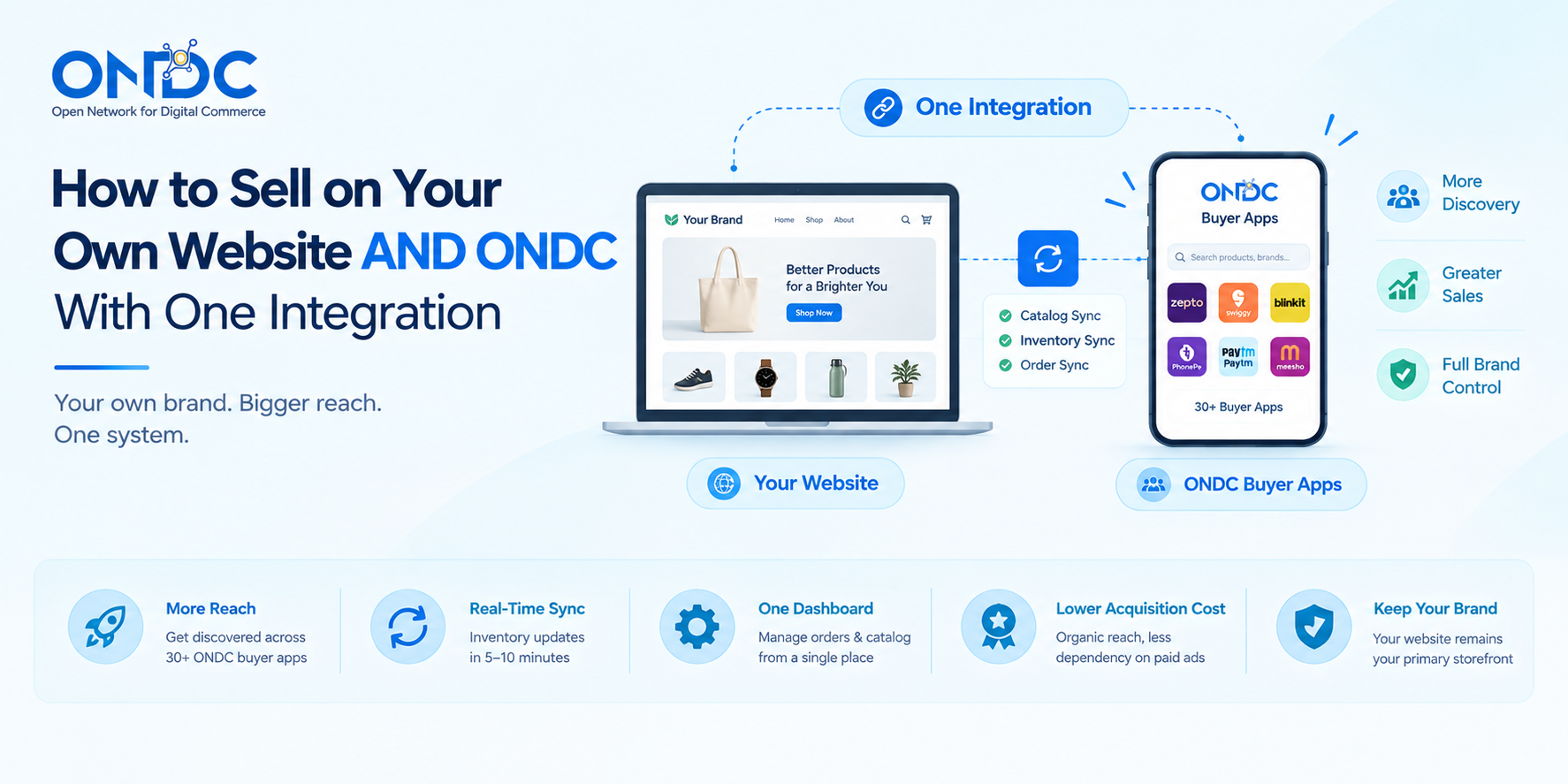
How to Sell on Your Own Website AND ONDC With One Integration
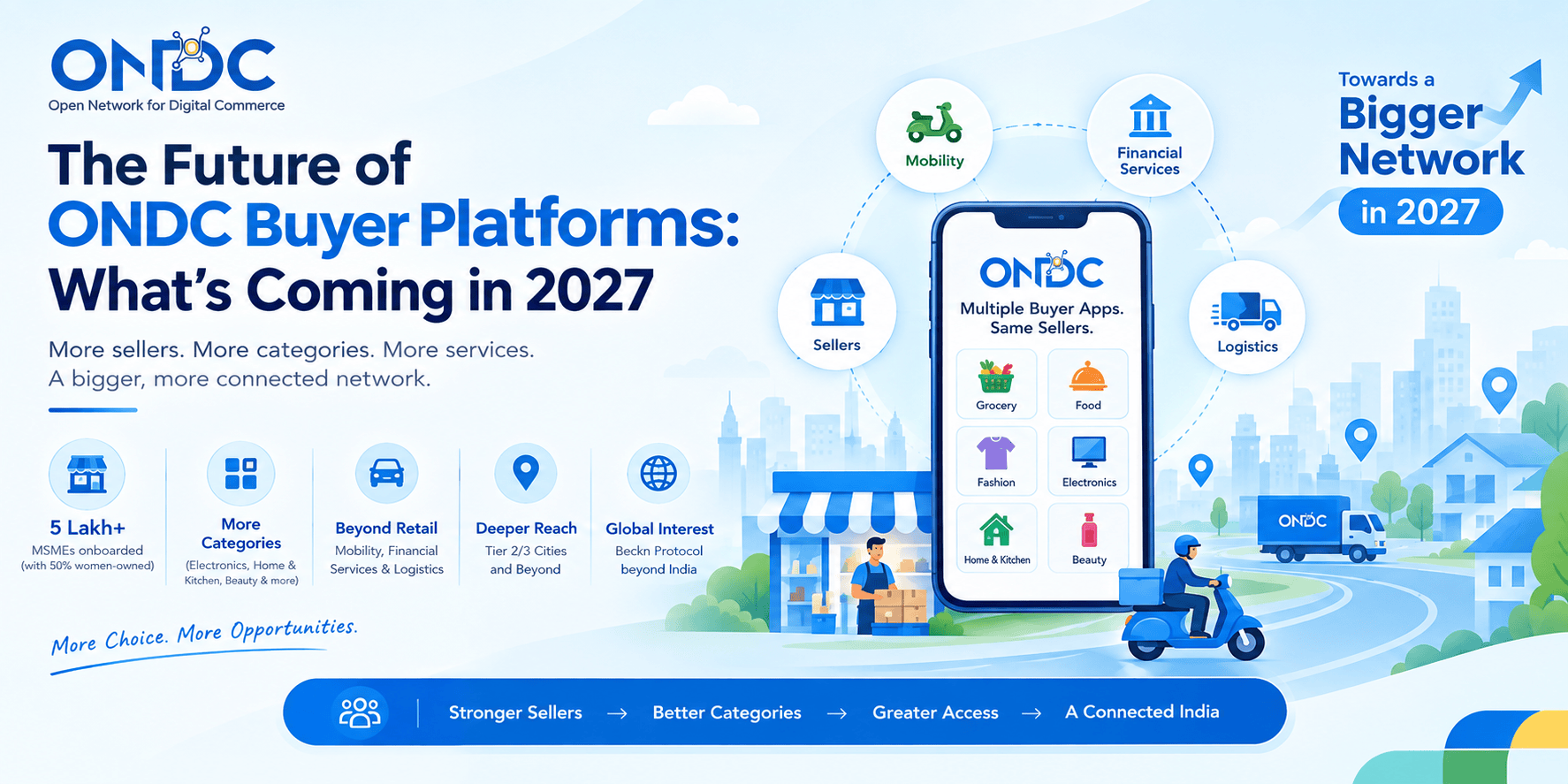
Future of ONDC Buyer Platforms: What's Coming in 2027
.png)
How Logistics & Delivery Partners Plug Into ONDC Buyer Platforms
.png)
Sounds like COSTBO might be the right choice for your business?
Get started by registering your business today! If you have any questions, we're here to help. Our team will reach out to you with detailed information about our offerings, product features, and a demo