

Future of ONDC Buyer Platforms: What's Coming in 2027
Explore the future of ONDC buyer platforms in 2027, including MSME growth, new categories, mobility, financial services, and wider network expansion.
Quick Answer
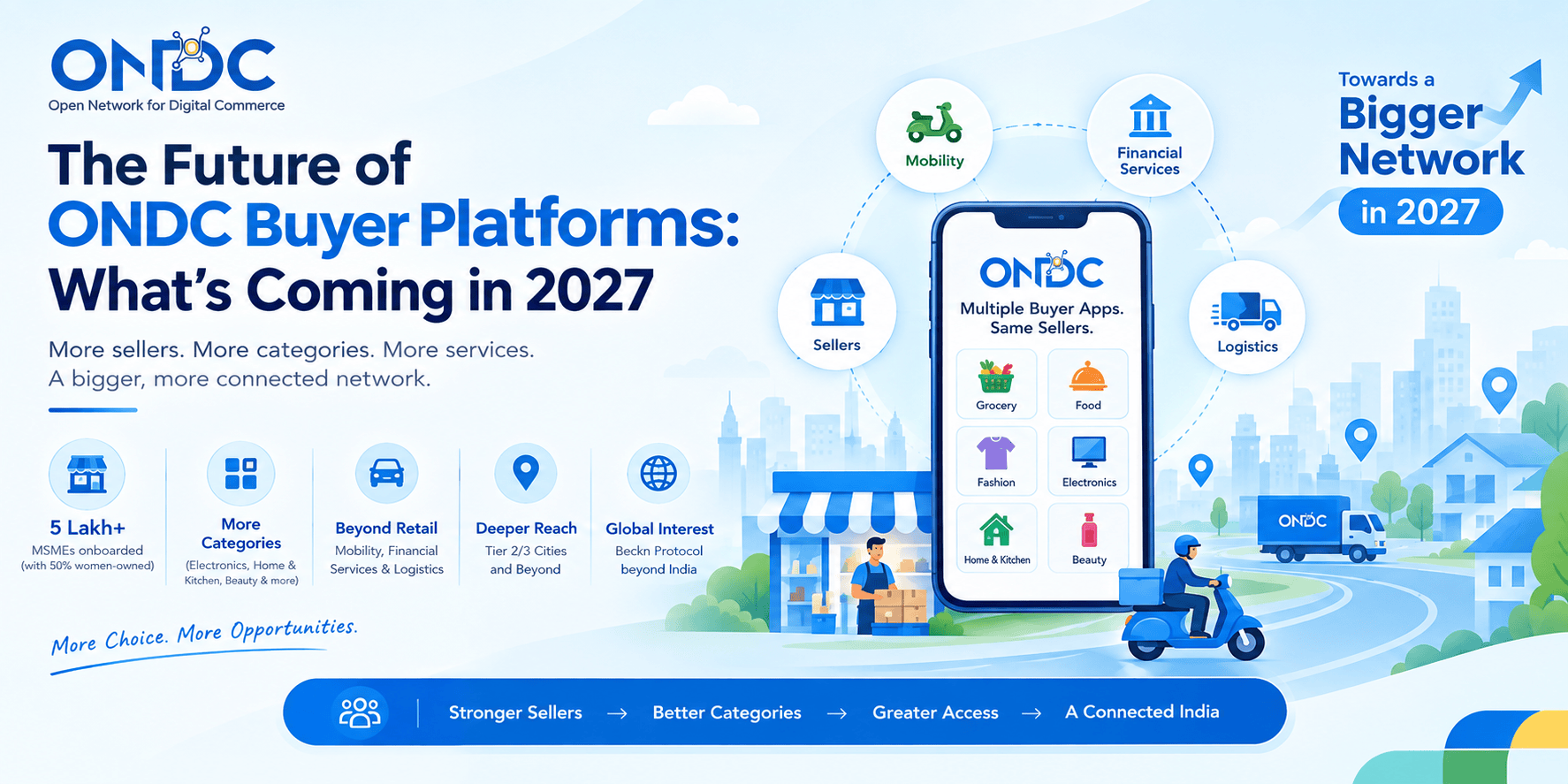
By 2027, ONDC is on track to look meaningfully bigger and more diverse than it does today: the government has committed roughly ₹277 crore to onboard 5 lakh additional MSMEs — half of them women-owned — through its TEAM scheme, and the network is actively expanding beyond retail into mobility, financial services (digital lending), and logistics. Category coverage in electronics, home & kitchen, and beauty & personal care is expected to mature further, and there's early-stage interest in the underlying Beckn Protocol spreading beyond India. None of this is guaranteed on a fixed timeline, but it's the direction current government commitments and network expansion clearly point toward.
Predicting exactly what any network looks like a year out is always somewhat speculative — but ONDC is unusual in that a meaningful chunk of its near-term future is already backed by specific, funded government commitments rather than just industry buzz. Based on what's currently planned and already underway, here's a grounded look at what buyer platforms on ONDC are likely to look like heading into 2027, and what's still genuinely uncertain.
What's Actually Funded and Committed
Unlike vague roadmap talk, these are specific, budgeted initiatives already in motion:
- The government has proposed a ₹277 crore investment specifically to onboard 5 lakh MSMEs onto ONDC by 2027, through what's known as the TEAM scheme — running from 2024 to 2027 and providing financial assistance for catalogue preparation, account management, logistics, and packaging
- Half of the targeted 5 lakh MSMEs — 2.5 lakh — are earmarked as women-owned enterprises, with outreach specifically prioritizing Tier 2 and Tier 3 cities and MSME clusters
- ONDC has already expanded beyond pure retail into mobility (onboarding apps like Namma Yatri) and financial services, including digital lending partnerships with banks and fintechs such as HDFC Bank, IDFC First Bank, and several NBFCs
This MSME-onboarding push is the single most concrete, dated commitment shaping what ONDC's seller and buyer-side experience will look like by 2027 — far more buyers in Tier 2/3 cities are likely to encounter ONDC-powered options simply because far more local sellers will be on the network.
Category Expansion: Where the Gaps Are Closing
- Grocery, food delivery, and fashion are already relatively mature categories on ONDC, with established seller density and buyer familiarity
- Electronics, home & kitchen, and beauty & personal care have been flagged as categories still scaling up, with more seller onboarding expected to bring them closer to grocery and food delivery's maturity level by 2027
- As MSME onboarding accelerates through the TEAM scheme, expect category depth to keep improving unevenly — some categories will likely mature faster than others depending on how easily local sellers in that category can digitize their catalog and operations
Beyond Retail: Mobility and Financial Services
One of the more significant 2027-relevant shifts is that ONDC is no longer purely an e-commerce initiative. It has already opened its network to mobility (ride-hailing style bookings) and financial services, using the same underlying Beckn Protocol interoperability mechanism that powers product discovery in retail. If this expansion continues at its current pace, buyer apps on the network could increasingly bundle shopping, mobility, and financial services access side by side — though how fast and how deeply this integration reaches ordinary buyer apps remains genuinely uncertain.
ONDC & Buyer Platforms — 2026 vs Expected 2027
The More Uncertain Bets
- International adoption of the Beckn Protocol — FIDE (the non-profit behind Beckn) has expressed intent to promote the protocol's adoption beyond India, but this is an early-stage ambition rather than a funded, dated commitment like the MSME scheme
- Closing the gap with UPI-level adoption — as covered in our comparison of ONDC and UPI's very different adoption curves, e-commerce is a structurally harder problem to standardize than payments, so a 2027 milestone matching UPI's growth trajectory shouldn't be assumed even as MSME onboarding accelerates
- Deeper quick commerce integration — hyperlocal and 15-20 minute delivery has been growing on the network, but how standardized and widespread this becomes by 2027 depends heavily on logistics partner expansion, which is progressing but not centrally mandated
What This Could Mean for Buyers by 2027
- More local, Tier 2/3 city sellers visible on ONDC buyer apps, simply as a function of the funded MSME onboarding push reaching further into smaller cities
- Stronger category depth in electronics, home & kitchen, and beauty — categories that currently feel thinner than grocery or food delivery on many ONDC buyer apps
- Possibly more integrated experiences bundling shopping with mobility or financial services within the same buyer app ecosystem, building on the same network effect that already lets one seller appear across many different buyer apps
What This Could Mean for Sellers by 2027
- More government-funded onboarding support available, particularly for MSMEs and women-owned businesses, through schemes like TEAM
- Increased competition as more sellers join, especially in categories that mature quickly — reinforcing the importance of solid catalog quality and reliable fulfillment as differentiators
- Continued cost advantages relative to closed marketplaces, assuming the lower-commission structure that currently defines ONDC holds as the network scales
Frequently Asked Questions
Is ONDC's 2027 MSME target officially funded, or just a goal?
It's an officially proposed, budgeted government initiative — roughly ₹277 crore committed to onboarding 5 lakh MSMEs by 2027 through the TEAM scheme, which runs from 2024 to 2027.
Will ONDC expand beyond e-commerce by 2027?
It already has — ONDC has onboarded mobility apps like Namma Yatri and financial services partners for digital lending, and this expansion beyond pure retail is expected to continue, though the pace and depth of integration into everyday buyer apps is still developing.
Will ONDC reach UPI-level scale by 2027?
Unlikely to fully close that gap — e-commerce is a structurally more complex problem than payments to standardize, and ONDC's adoption curve has already been slower than UPI's was in its first years, even with accelerating MSME onboarding.
Which product categories are expected to grow most on ONDC by 2027?
Electronics, home & kitchen, and beauty & personal care have been specifically flagged as categories still scaling up, with more seller onboarding expected to close the gap with more mature categories like grocery and food delivery.
Is the Beckn Protocol expanding to other countries?
There's early-stage interest and intent from FIDE, the non-profit behind the protocol, to promote adoption beyond India, but this remains a developing ambition rather than a confirmed, dated rollout.
The Realistic Outlook
The most confident part of this forecast is also the most boring one: government-funded MSME onboarding will keep expanding ONDC's seller base through 2027, because that funding and timeline are already locked in. Everything layered on top of that — deeper category maturity, mobility and fintech integration, international protocol adoption — is directionally likely but genuinely uncertain in pace. Worth revisiting this outlook periodically as the TEAM scheme progresses and category data becomes clearer.
About Costbo
Founded by Mr. Eswar and Mr. Ananth, with nearly 20 years of technology experience, Costbo is a leading ONDC seller platform powering India’s open digital commerce ecosystem. Costbo is among the first ONDC 1.2.0 certified seller platforms, enabling brands and sellers to sell on ONDC with fast onboarding, lower costs, and full operational control.
Ready to grow on ONDC? Start your journey with Costbo today.
References
• Government Plans Rs 277 Crore Push To Onboard 5 Lakh MSMEs On ONDC By 2027 — KNN India
• Revolutionizing Digital Commerce: The ONDC Initiative — Press Information Bureau, Govt. of India
• India government-backed ONDC expands to mobility — TechCrunch
• India's Open Commerce Network Expands into Digital Lending — TechCrunch
Read More
- Building Blocks of ONDC: A Detailed Guide to India’s Open Digital Commerce Infrastructure
- ONDC A Revolutionary Open eCommerce Network – in Action
- Roles of Seller App & Buyer App on ONDC Network
- Why Sell Online Through the ONDC Network?
- Getting Started as a Seller on ONDC: Registration Options
- Which Is the Best ONDC Seller App? Features, Pros & Cons (2026)
- Best ONDC Buyer Apps in 2026: Features, Pros & Cons
- What is ONDC Buyer App
Related post
How to Sell on Your Own Website AND ONDC With One Integration
.png)
How Logistics & Delivery Partners Plug Into ONDC Buyer Platforms
.png)
.png)
How Multiple Buyer Apps Access the Same Sellers on ONDC (Network Effect Explained Simply)
Sounds like COSTBO might be the right choice for your business?
Get started by registering your business today! If you have any questions, we're here to help. Our team will reach out to you with detailed information about our offerings, product features, and a demo