

Which Is the Best ONDC Seller App ? Features, Pros & Cons (2026)
Compare the best ONDC seller apps in India (2026). Features, pros & cons, scalability, and why Costbo leads MSME to enterprise sellers.

India’s e-commerce landscape is undergoing a structural transformation. At the center of this shift is the Open Network for Digital Commerce (ONDC), a Government of India–backed initiative launched in 2023 to democratize digital commerce. ONDC separates the ecosystem into buyer apps, seller apps, and logistics/payment providers, enabling true platform neutrality—similar to how UPI transformed digital payments.
ONDC Scale & Growth: Key Data Points (2024–2026)
According to ONDC disclosures and industry estimates, the network has scaled rapidly:
- 350+ million cumulative transactions processed as of late 2025
- March 2025 alone: ~1.6 crore orders, contributing to 20.4 crore cumulative transactions
- Daily transaction run-rate (early 2025): 5–6 lakh orders per day
- Target by end of 2026: 50–60 lakh daily transactions (≈10× growth)
- Seller ecosystem:
- 7.6 lakh+ sellers and service providers onboarded by April 2025
- 1.16 lakh+ active retail sellers across 630+ cities by December 2025
- 7.6 lakh+ sellers and service providers onboarded by April 2025
- Sector-wise growth:
- Mobility accounts for ~40% of transactions, growing 120% in 8 months
- Non-mobility categories grew 825%, with food delivery up 300%
- Mobility accounts for ~40% of transactions, growing 120% in 8 months
- Enterprise participation:
- 8 lakh+ service providers integrated, including brands like Domino’s, Unilever, Haldiram’s, and Wow! Momo
- 8 lakh+ service providers integrated, including brands like Domino’s, Unilever, Haldiram’s, and Wow! Momo
- Geographic reach:
- ONDC operations span 800+ cities and towns, with strong traction in Tier-2, Tier-3, and Bharat markets
A Reality Check on ONDC Platforms
While nearly 100 buyer and seller apps have been registered on ONDC historically (as listed on ONDC.org), the ecosystem has naturally matured:
- Many early apps have paused operations
- Several failed to upgrade with ONDC protocol changes
- Some remain pilot-only or inactive
- A smaller subset has emerged as stable, production-ready platforms
👉 This blog focuses only on the active, scalable ONDC Seller Apps in 2026, with a detailed comparison of their features, strengths, and limitations—so sellers can make informed, long-term decisions.
Top ONDC Seller Apps (2026)
Below are the most relevant ONDC seller platforms in 2026. While hundreds were listed, only a few have scaled reliably.
1. Costbo
India’s Leading ONDC Seller Platform
Overview:
Costbo is a full-stack, ONDC-native Seller Operating System, designed for sellers who want stability, scalability, and long-term growth on ONDC. It manages catalogues, inventory, orders, logistics, payments, and compliance across multiple buyer apps via one integration.
Pros:
✅ End-to-end ONDC seller lifecycle management
✅ Fully ONDC protocol–compliant (v1.2+)
✅ One seller → many buyer apps (Magicpin, DigiHaat, Bajaj Markets, etc.)
✅ Enterprise-grade automation, analytics & reporting
✅ Suitable for MSMEs, D2C brands & large sellers
Cons:
⚠️ Built for serious sellers; not ideal for hobby or one-product sellers
2. ShopClues
Overview:
ShopClues participates in ONDC mainly as a marketplace extension, enabling selected sellers to gain ONDC visibility through its ecosystem.
Pros:
✅ Familiar platform for existing ShopClues sellers
✅ Marketplace-led product discovery
Cons:
⚠️ Limited seller control
⚠️ Not a standalone ONDC seller operating system
⚠️ Restricted customization and analytics
3. Mystore
Overview:
Mystore is a basic ONDC seller storefront, focused on fast onboarding for micro and small retailers.
Pros:
✅ Quick and simple onboarding
✅ Low technical complexity
✅ Suitable for local sellers
Cons:
⚠️ Limited automation & reporting
⚠️ Not scalable for high-volume sellers
⚠️ Basic inventory and order workflows
4. UdyamWell
Overview:
UdyamWell focuses on assisted MSME onboarding, helping traditional businesses adopt ONDC with hand-holding and support.
Pros:
✅ MSME-friendly approach
✅ Assisted onboarding and guidance
✅ Good for first-time digital sellers
Cons:
⚠️ Limited platform automation
⚠️ Service-heavy, not tech-scalable
⚠️ Not ideal for fast-growing D2C brands
5. Shiprocket
Overview:
Shiprocket’s ONDC role is logistics-first, enabling sellers with shipping, fulfillment, and delivery integrations.
Pros:
✅ Strong nationwide logistics network
✅ Reliable last-mile delivery
✅ Good for shipping-intensive sellers
Cons:
⚠️ Not a full ONDC seller OS
⚠️ Limited catalog & order orchestration
⚠️ Depends on external seller platforms
6. Vikra (Zoho)
Overview:
Vikra connects ONDC with Zoho’s ERP and CRM ecosystem, allowing Zoho users to extend operations to ONDC.
Pros:
✅ Seamless for Zoho users
✅ ERP-aligned workflows
✅ Good internal data sync
Cons:
⚠️ ONDC is not the primary focus
⚠️ Limited ONDC-specific optimization
⚠️ Best only within Zoho ecosystem
7. ChattyBao Technologies Pvt Ltd
Overview:
ChattyBao acts as a technology enabler, supporting backend ONDC integrations and pilot implementations.
Pros:
✅ Flexible tech-first approach
✅ Custom integration capability
Cons:
⚠️ Not a merchant-friendly platform
⚠️ Limited seller dashboards & tooling
⚠️ More suitable for pilots than scale
8. Easy Pay Pvt. Ltd.
Overview:
Easy Pay operates at the intersection of payments and assisted commerce, supporting transaction flows on ONDC.
Pros:
✅ Strong payment & settlement capabilities
✅ Useful for assisted/offline retail
Cons:
⚠️ Limited commerce automation
⚠️ Weak catalog & inventory features
⚠️ Not suitable for D2C growth
9. Fynd
Overview:
Fynd brings fashion and lifestyle commerce expertise into ONDC, supporting brands with inventory-heavy operations.
Pros:
✅ Strong fashion category depth
✅ Omnichannel inventory handling
✅ Brand-friendly workflows
Cons:
⚠️ Category-specific (fashion/lifestyle)
⚠️ Not ideal for general commerce sellers
10. Magicpin
Overview:
Magicpin is one of the most active ONDC ecosystem players, particularly strong in food delivery and hyperlocal commerce.
Pros:
✅ High transaction volumes
✅ Strong restaurant & local merchant network
✅ Acts as both buyer & seller-side enabler
Cons:
⚠️ Heavily focused on F&B
⚠️ Less suitable for pan-India D2C brands
11. NStore
Overview:
NStore focuses on offline-to-online retail enablement, allowing physical stores to list on ONDC.
Pros:
✅ Good for brick-and-mortar retailers
✅ Store-centric workflows
Cons:
⚠️ Limited enterprise features
⚠️ Smaller ecosystem reach
⚠️ Not built for scale-heavy sellers
12. Uengage
Overview:
Uengage is a restaurant POS and ordering platform extended to ONDC.
Pros:
✅ Strong POS + restaurant workflows
✅ Ideal for QSRs and cafes
Cons:
⚠️ Limited outside food category
⚠️ Not suitable for multi-category sellers
🧩 ONDC Seller App Comparison (2026)
Final Verdict
In 2026, ONDC is production-grade infrastructure, not an experiment.
While many seller apps solve one part of the problem — logistics, payments, POS, or category-specific needs — only Costbo solves the entire ONDC seller journey end-to-end.
👉 For sellers who want control, scale, compliance, and long-term success on ONDC, Costbo is the best ONDC Seller App in India.
Frequently Asked Questions (FAQs)
1. What is an ONDC Seller App?
An ONDC Seller App is a platform that enables businesses to list products, manage inventory, process orders, handle payments, and fulfill deliveries on the Open Network for Digital Commerce (ONDC). It acts as the operational backbone connecting sellers to multiple ONDC buyer apps.
2. Which is the best ONDC Seller platform in 2026?
In 2026, Costbo is considered the best ONDC Seller App/ ONDC Seller platform due to its full-stack capabilities, protocol compliance, multi buyer-app reach, and scalability from MSMEs to enterprise sellers.
3. How does ONDC work for sellers?
ONDC works for sellers through a seller app that connects their business to the open ONDC network. Here’s how it works step by step:
- Seller onboarding
Sellers register on an ONDC Seller Platform (such as Costbo, Mystore, etc.) by completing KYC, business verification, and store setup. - Product & catalog listing
Sellers upload products, prices, availability, and serviceable locations on the seller app. This catalog becomes visible across multiple ONDC buyer apps. - Discovery across buyer apps
Unlike marketplaces, sellers are not tied to one app. Buyers can discover the same seller and products on many ONDC buyer apps at the same time. - Order placement by buyers
When a customer places an order on any ONDC buyer app, the order is routed through the ONDC network to the seller’s app. - Order confirmation & processing
The seller receives the order, confirms availability, prepares the product, and initiates fulfillment. - Logistics & delivery
Delivery can be handled by integrated logistics partners, hyperlocal delivery, or seller-managed delivery, depending on the category and platform. - Payments & settlement
Payments are collected digitally and settled directly to the seller’s bank account as per ONDC settlement cycles, with transparent charges. - Ratings, returns & support
Buyer ratings, cancellations, returns, and customer support are managed through the seller platform as per ONDC protocols. - Analytics & growth
Sellers get dashboards for orders, revenue, buyer apps performance, and insights to improve pricing, inventory, and reach.
4. Why is choosing the right ONDC Seller App important?
ONDC seller success depends heavily on the seller app’s:
- Protocol compliance
- Order and inventory automation
- Payment reconciliation
- Logistics integration
- Scalability
A weak seller app can lead to failed orders, poor buyer ratings, and stalled growth — even if buyer demand exists.
5. Can I sell on multiple ONDC buyer apps using one seller app?
Yes. A strong seller app like Costbo allows a single integration to sell across multiple ONDC buyer apps (such as Magicpin, DigiHaat, Bajaj Markets, Mystore, etc.), eliminating the need for separate integrations.
6. Is ONDC suitable for small businesses and MSMEs?
Yes. ONDC is specifically designed to empower MSMEs, kirana stores, D2C brands, and regional sellers by reducing platform dependency, lowering commissions, and enabling fair discovery through an open network.
7. Do I need technical expertise to sell on ONDC?
Not necessarily. Most ONDC Seller Apps provide assisted onboarding and managed dashboards. Platforms like Costbo handle technical integrations, compliance, and protocol updates, allowing sellers to focus on business operations.
8. Are all ONDC Seller Apps active and reliable?
No. While 100+ seller apps were listed historically, many have:
- Shut down operations
- Failed protocol upgrades
- Remained pilot-only
- Stopped seller onboarding
This makes choosing a stable and continuously upgraded seller platform critical.
9. How does ONDC differ from Amazon or Flipkart for sellers?
Unlike closed marketplaces:
- ONDC does not own customers or inventory
- Sellers are not locked into one platform
- Discovery happens across multiple buyer apps
- Seller apps provide operational control
ONDC functions more like UPI for e-commerce than a traditional marketplace.
10. Is ONDC backed by the Government of India?
Yes. ONDC is a Government of India–backed initiative, developed under DPIIT to create open, interoperable digital commerce infrastructure across the country.
11. Is ONDC ready for large-scale commerce in 2026?
Yes. By 2026, ONDC has moved beyond pilots and is handling millions of transactions per month across categories like grocery, food, electronics, fashion, and FMCG — making it production-ready for serious sellers.
12. What are the Popular ONDC Seller Apps/Platforms in 2026?
Here are the major ONDC Seller Platforms in 2026 (active & relevant):
- Costbo – Full-stack ONDC Seller Platform
- Magicpin – Hyperlocal & food-led ONDC platform
- Fynd – Fashion & lifestyle ONDC seller platform
- Shiprocket – Logistics-first ONDC integration
- Mystore – Entry-level ONDC seller storefront
- UdyamWell – Assisted MSME ONDC onboarding
- ShopClues – Marketplace-based ONDC participation
- Vikra (Zoho) – ERP-linked ONDC seller integration
- Uengage – Restaurant POS + ONDC
- NStore – Offline-to-online ONDC retail enablement
13. Which is the most comprehensive ONDC Seller Platform in 2026?
Costbo is considered the most comprehensive ONDC Seller Platform in 2026 because it offers end-to-end seller lifecycle management—catalog, inventory, orders, logistics, payments, analytics, and ONDC protocol compliance—through a single integration.
References
- Open Network for Digital Commerce (ONDC) – Official Website
https://ondc.org - DPIIT – Government of India (ONDC Initiative)
https://dpiit.gov.in
Policy framework and ONDC governance
Read More
- Building Blocks of ONDC: A Detailed Guide to India’s Open Digital Commerce Infrastructure
- ONDC A Revolutionary Open eCommerce Network – in Action
- Roles of Seller App & Buyer App on ONDC Network
- Why Sell Online Through the ONDC Network?
- Getting Started as a Seller on ONDC: Registration Options
- Which Is the Best ONDC Seller App? Features, Pros & Cons (2026)
- Best ONDC Buyer Apps in 2026: Features, Pros & Cons
Related post
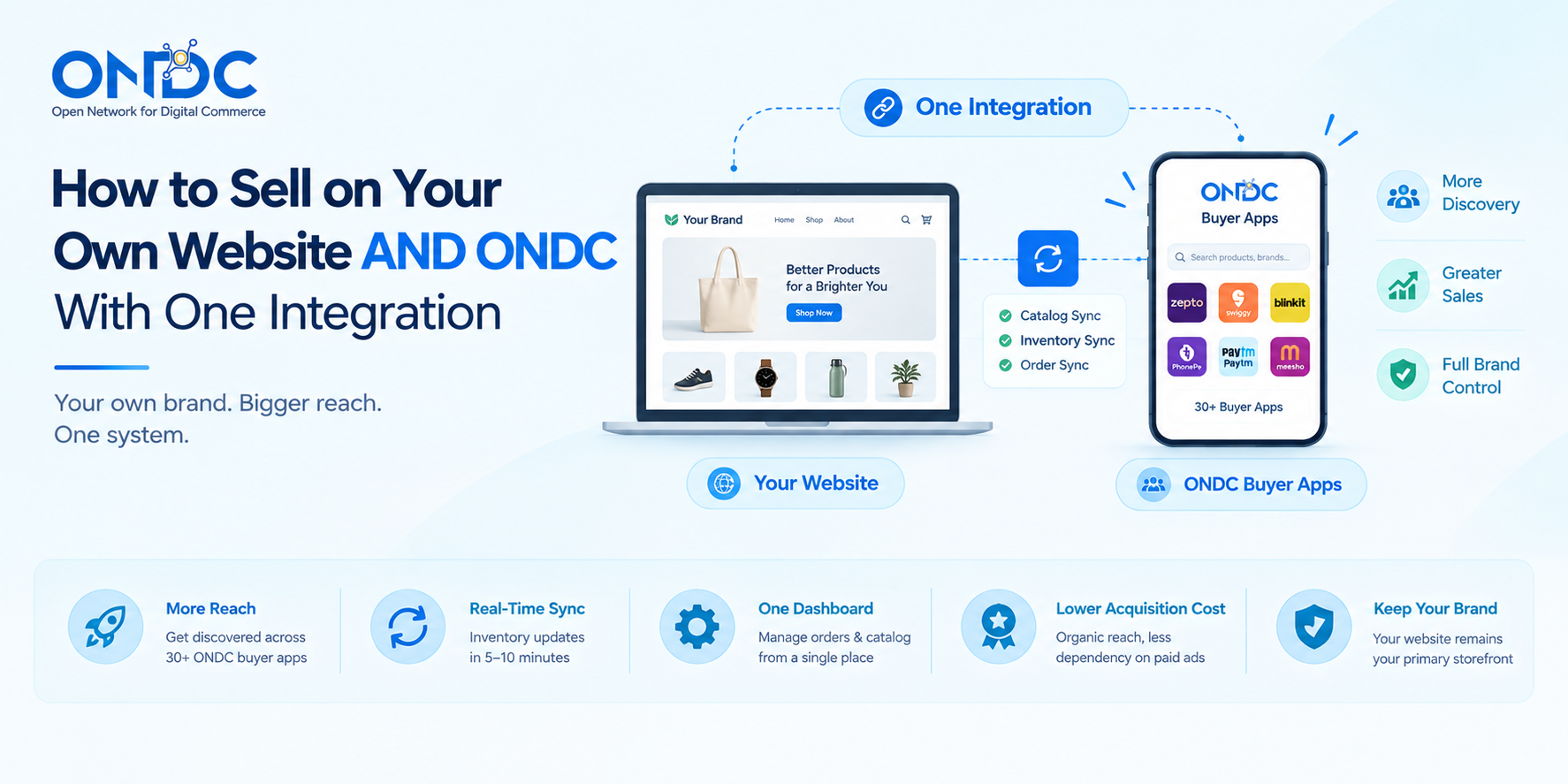
How to Sell on Your Own Website AND ONDC With One Integration
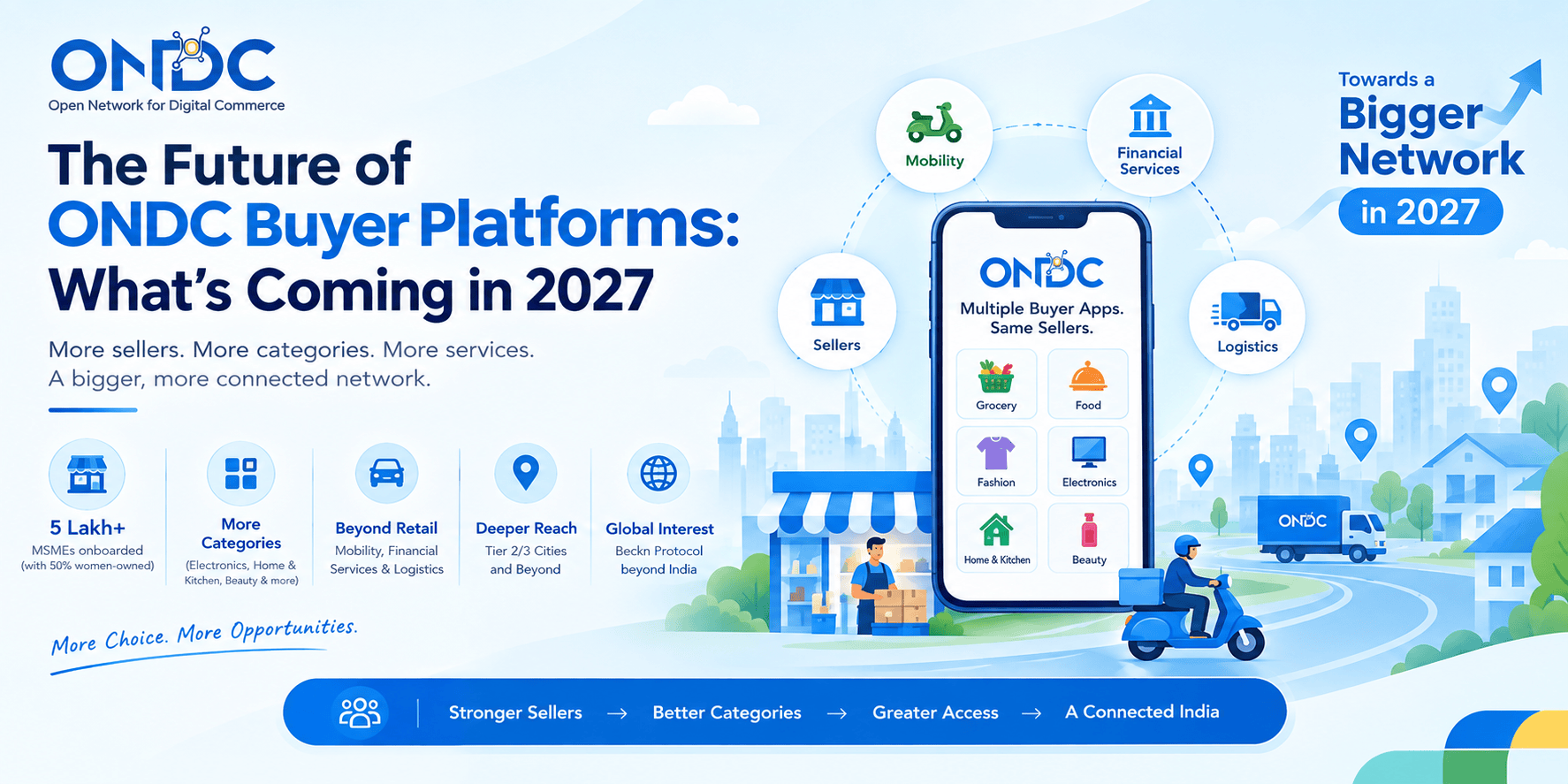
Future of ONDC Buyer Platforms: What's Coming in 2027
.png)
How Logistics & Delivery Partners Plug Into ONDC Buyer Platforms
.png)
Sounds like COSTBO might be the right choice for your business?
Get started by registering your business today! If you have any questions, we're here to help. Our team will reach out to you with detailed information about our offerings, product features, and a demo