

How to Choose the Right ONDC Seller Platform for Your Business in 2026
Choosing an ONDC seller platform in 2026? Compare features, pricing, integrations, and support to find the best ONDC partner for your business growth.

India's e-commerce landscape is going through a structural shift. The Open Network for Digital Commerce (ONDC) — a Government of India initiative launched by the Department for Promotion of Industry and Internal Trade (DPIIT) — is doing for digital commerce what UPI did for payments: breaking open a closed ecosystem and making it accessible to everyone.
Before ONDC, if you wanted to sell online, you had three choices: pay Amazon's or Flipkart's hefty commissions (15–35% depending on category), build your own website and fight for traffic, or accept that you'd be invisible to most Indian online shoppers. Large platforms dictated discovery, pricing visibility, and return policies — and sellers had little say.
ONDC changes the equation. It is an open protocol, not a marketplace. Sellers list products through a Seller App. Buyers discover them through whichever Buyer App they prefer — Paytm, PhonePe Pincode, Meesho, or dozens of others. Logistics providers plug in independently. Everyone operates on the same open standard (the Beckn Protocol), so a seller listed on one platform is discoverable from all buyer apps on the network.
The numbers in 2026 speak for themselves. ONDC has crossed 100 million transactions, operates across 400+ cities and towns, and has onboarded over 5 lakh sellers. Grocery and Food & Beverage alone account for more than 50% of total transactions. And the network is actively expanding into fashion, electronics, mobility, financial services, FMCG, and agriculture.
But here is the nuance that most sellers miss: you cannot join ONDC directly. You need a Seller Platform (also called a Seller Network Participant or SNP) to list your products, manage orders, handle logistics, and receive payments on your behalf. The platform you choose will determine your onboarding speed, commission costs, operational control, category reach, and — ultimately — how much money you make.
This guide will help you cut through the noise and choose the right ONDC seller platform for your business in 2026.
How ONDC Works: The 60-Second Version
Think of ONDC as a highway. You don't live on the highway — you need a vehicle to use it. Your Seller Platform is that vehicle.
Here's the flow:
- You register with a Seller Platform and upload your catalog.
- Your Seller Platform lists your products on the ONDC network.
- A buyer on any Buyer App (Paytm, PhonePe, etc.) searches for a product.
- Your listing appears in their search results.
- They place an order. Your Seller Platform routes it to you.
- Logistics is handled either by integrated partners or your own courier.
- Payment is settled by the platform within the agreed timeline.
Because the network is open, your products are automatically visible across all active buyer apps — not just one. That multi-platform reach, at a fraction of traditional marketplace commissions, is ONDC's core value proposition.
Commission structure in 2026: ONDC itself charges ₹1.5 per successful transaction above ₹250 (introduced January 2025). Individual Seller Platforms charge their own fees on top — typically ranging from 3% to 12%, significantly lower than the 20–35% charged by traditional marketplaces.
7 Key Factors to Evaluate When Choosing an ONDC Seller Platform
Before you look at individual platforms, define what your business actually needs. The right platform for a kirana store in Coimbatore is very different from the right platform for a D2C electronics brand in Bengaluru.
Use these seven factors as your evaluation framework.
1. Category Fit
Not every platform supports every product category well. ONDC covers grocery, F&B, fashion, electronics, FMCG, mobility, and services — but individual Seller Platforms may be stronger in specific verticals.
Ask yourself:
- Is my category (food, grocery, fashion, electronics, services) well-supported on this platform?
- Does the platform have a strong merchant base in my category already?
- Are there category-specific features — like restaurant menus, variant management for clothing, or SKU-level inventory for FMCG?
A restaurant using a platform built primarily for physical retail will struggle with menu management and real-time availability updates. A fashion seller needs robust size/color variant support. Match the platform's core strength to your business type.
2. Onboarding Speed and Simplicity
Time-to-live matters. Every day your products aren't listed is a day you're not selling. Onboarding timelines across ONDC Seller Platforms vary from 24 hours to several weeks depending on document verification, catalog upload complexity, and the level of support offered.
What to check:
- Does the platform offer assisted onboarding or self-serve?
- How long does GST and document verification take?
- Is there a bulk catalog upload tool, or do you have to add products one by one?
- Is there dedicated onboarding support (phone, WhatsApp, relationship manager)?
For new sellers with no prior e-commerce experience, assisted onboarding is worth paying a small premium for. Getting stuck at the catalog stage and going live six weeks late is a far more expensive problem than a slightly higher platform fee.
3. Commission and Fee Structure
This is the most misunderstood factor. The headline commission rate (3%–12%) is only part of the picture. Some platforms layer additional fees on top: monthly subscriptions, catalog management fees, logistics markups, or settlement delays that cost you working capital.
What to map out before signing up:
- Base platform commission (percentage of order value)
- Fixed monthly or annual subscription fee, if any
- Logistics fee — is it transparent, or does the platform take a cut on shipping?
- Payment settlement cycle — daily, weekly, or longer?
- Any catalog or listing fees for adding new products?
- ONDC network fee (₹1.5 per transaction above ₹250) — does the platform absorb this or pass it to you?
Build a simple unit economics model. Take your average order value, apply all fees, subtract COGS and shipping, and check what margin is left. Do this for 2–3 shortlisted platforms before committing.
4. Technology and Integration Capabilities
If you already use a POS system, ERP, inventory management tool, or a separate website (Shopify, WooCommerce), your ONDC Seller Platform should integrate with it — not require you to manage a completely parallel workflow.
Key integrations to look for:
- POS integration (critical for offline-first retailers)
- Inventory sync with your existing warehouse management system
- ERP connectivity (Tally, SAP, Zoho Books)
- Existing website / D2C store sync
- WhatsApp or CRM integration for order notifications and customer communication
- API access for custom development
If you're running a multi-location business or managing thousands of SKUs, a platform with robust API access and ERP integration will save enormous operational overhead. Platforms that force you into their standalone dashboard — with no export or sync capability — create data silos that hurt you at scale.
5. Logistics Coverage and Quality
Your ONDC listing can be perfect, but if deliveries are consistently late or your pin code coverage is patchy, you'll rack up cancellations and bad reviews. Logistics is the silent destroyer of ONDC seller reputation.
What to evaluate:
- Which logistics partners are integrated? (Delhivery, Shiprocket, Shadowfax, Ecom Express, etc.)
- What is the pin code coverage? Does it reach the cities and towns you want to target?
- Can you use your own logistics (hyperlocal delivery, own vehicles)?
- How is reverse logistics and returns handled? What is the return settlement timeline?
- Does the platform give you real-time shipment tracking and delivery alerts?
For food and grocery sellers specifically, hyperlocal delivery within 2–4 hours is the baseline expectation. Verify whether the platform supports this model or is optimized for next-day / 2-day delivery only.
6. Analytics, Reporting, and Seller Dashboard
Selling blind is selling badly. Your platform should give you the data to understand which products are selling, where your orders are coming from, what your cancellation rate is, and where you're losing money.
Minimum analytics you should expect in 2026:
- Order volume and revenue trends (daily/weekly/monthly)
- Top-selling products and categories
- Cancellation and return rate by product
- Buyer app-wise order breakdown (which buyer app drives most orders)
- Logistics performance — on-time delivery rate by courier partner
- Payment settlement reports with reconciliation
Advanced platforms will layer on customer behavior data, search ranking insights, and category benchmarks. Even if you don't need all of this on Day 1, choose a platform that grows with you — because you'll want these insights once you're at scale.
7. Support Quality and Seller Community
When something goes wrong — and it will, especially in the early months — the quality of support you receive can make the difference between a recoverable problem and a business crisis. Order disputes, payment holds, catalog errors, and logistics failures all require fast human intervention.
What to assess:
- Is support available via phone, WhatsApp, or only email/ticket?
- What is the stated response time? What is the actual response time?
- Is there a dedicated account manager for your business size/category?
- Is there an active seller community (WhatsApp group, forum) where you can learn from peers?
- Does the platform offer seller training resources — tutorials, webinars, help docs?
Read reviews on Trustpilot, Google, and LinkedIn before you commit. Talk to 2–3 sellers already using the platform if you can. Support quality is the one factor that is completely invisible until you need it.
Overview of Major ONDC Seller Platforms in 2026
Here is a functional breakdown of the major platforms active in 2026 and who they are best suited for.
Platform Comparison at a Glance
This is not an exhaustive list. New platforms are being certified regularly as ONDC scales. Always verify that your shortlisted platform holds an active ONDC network participant certification before signing up.
Decision Framework: Match Your Business Profile to a Platform
Use this quick guide to identify where to start.
You are a kirana store or local grocery shop: Prioritize ease of use, assisted onboarding, and hyperlocal delivery support. Mystore, eSamudaay, or Digiit are strong starting points. Look for platforms with WhatsApp-based order management — your staff is unlikely to use a complex dashboard.
You are a restaurant or cloud kitchen: You need real-time menu management, instant order alerts, and 30–60 minute delivery capability. Magicpin, Uengage, or eSamudaay are better fits. Verify that the platform integrates with your existing POS system.
You are a D2C brand (fashion, electronics, health/beauty): You need catalog depth (variants, attributes, images), strong buyer app reach, and good analytics. Mystore or Costbo are worth evaluating. Also check whether the platform supports multi-city warehousing if you stock inventory in multiple locations.
You are a mid-size or large retailer with existing ERP/POS: Integration capability is your top priority. GoFrugal or Costbo, both of which have deep ERP integration, are your best starting points. Request a technical integration demo before committing.
You are an FMCG brand wanting to reach small retailers (B2B2C): This is a more specialized use case. Costbo has begun enabling B2B seller journeys on ONDC. Evaluate platforms that explicitly support bulk ordering and B2B pricing structures.
Common Mistakes to Avoid
Choosing based on price alone. The cheapest platform by headline commission may cost you more in aggregate — through poor logistics coverage, slow settlements, or weak catalog support that results in low discoverability. Do full unit economics, not just commission math.
Skipping the pilot. Most platforms allow you to onboard and test with a small subset of products before going full scale. Use this. List 20–30 products, run live for 4 weeks, and measure actual order volume, logistics performance, and support responsiveness before committing your full catalog.
Ignoring logistics coverage. If your target customers are in Tier-2 cities and your platform's logistics partners don't cover those pin codes reliably, your ONDC presence is essentially decorative. Map your top 10 target cities against the platform's coverage before signing up.
Not reading the payment settlement terms. Settlement cycles of 7–14 days can create serious cash flow problems for small sellers. Understand exactly when you get paid and whether there are any holds triggered by returns or disputes.
Going live with a weak catalog. ONDC buyer apps use product discovery algorithms. Products with poor images, missing attributes, or incomplete descriptions are buried. Invest in catalog quality upfront — good images, accurate titles, complete specifications, and competitive pricing.
What to Do Before You Onboard: A Quick Checklist
- Business registration documents (GST certificate, MSME/Udyam certificate if applicable)
- Bank account linked to GST-registered entity
- PAN card and Aadhaar for KYC
- FSSAI license (mandatory for food/grocery sellers)
- Product catalog ready — images (minimum 800x800px), titles, descriptions, prices, HSN codes
- Logistics setup decision — platform-integrated courier or your own delivery?
- Return and refund policy documented
- Designated staff member responsible for order management and dispatch
Having these ready before you contact a platform reduces onboarding time from weeks to days.
The Bottom Line
ONDC in 2026 is no longer an experiment — it is a legitimate, fast-growing commerce channel with real transaction volume, real buyer apps, and real sellers making real money. The network's expansion to 400+ cities, its multi-category growth, and the entry of serious buyer apps like PhonePe Pincode, Paytm, and Meesho mean that product discovery is becoming genuinely competitive with traditional marketplaces.
The platform you choose is the single biggest variable in your ONDC success. A well-matched platform with good logistics, strong catalog tools, and responsive support will get you to your first 100 orders significantly faster than the wrong platform with a slightly lower commission rate.
Do your evaluation seriously. Pilot before you commit. And treat ONDC not as a replacement for everything else, but as a powerful additional distribution channel — one that reaches millions of buyers without the margin erosion of traditional marketplace gatekeepers.
About Costbo
Founded by Mr. Eswar and Mr. Ananth, with nearly 20 years of technology experience, Costbo is a leading ONDC seller platform powering India’s open digital commerce ecosystem. Costbo is among the first ONDC 1.2.0 certified seller platforms, enabling brands and sellers to sell on ONDC with fast onboarding, lower costs, and full operational control.
Ready to grow on ONDC? Start your journey with Costbo today.
Read More
- Building Blocks of ONDC: A Detailed Guide to India’s Open Digital Commerce Infrastructure
- ONDC A Revolutionary Open eCommerce Network – in Action
- Roles of Seller App & Buyer App on ONDC Network
- Why Sell Online Through the ONDC Network?
- Getting Started as a Seller on ONDC: Registration Options
- Which Is the Best ONDC Seller App? Features, Pros & Cons (2026)
- Best ONDC Buyer Apps in 2026: Features, Pros & Cons
- What is ONDC Buyer App
Related post
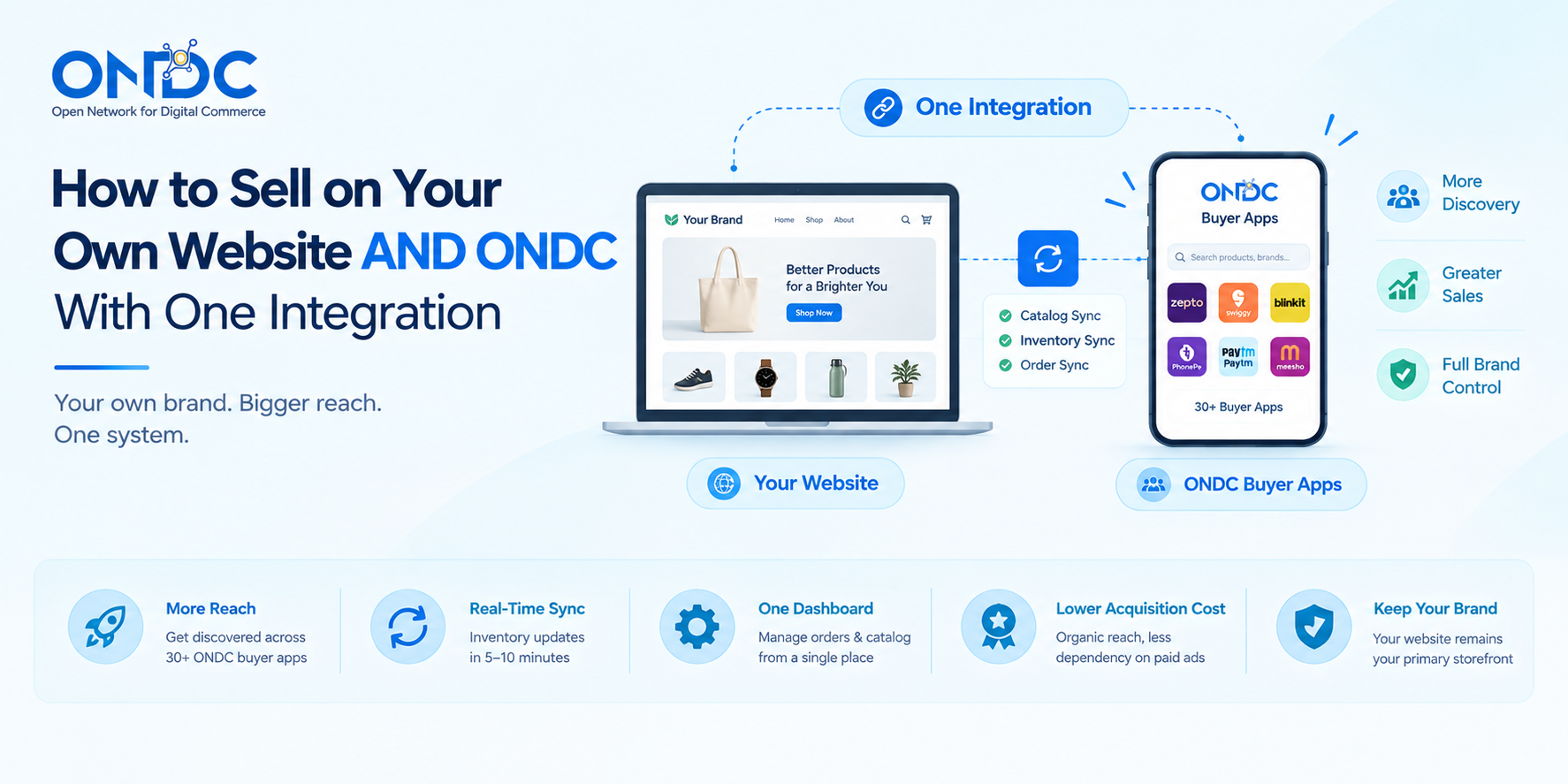
How to Sell on Your Own Website AND ONDC With One Integration
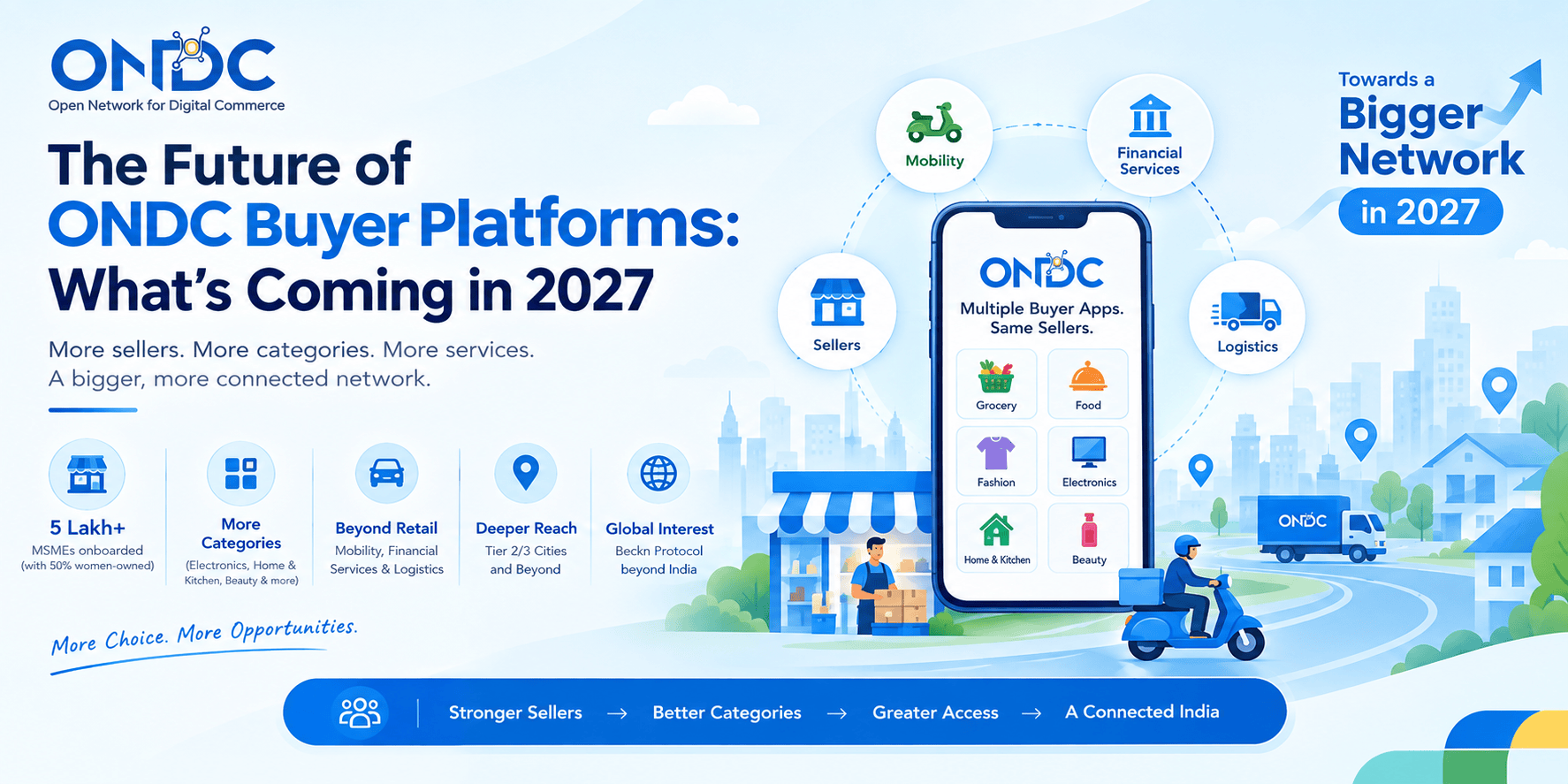
Future of ONDC Buyer Platforms: What's Coming in 2027
.png)
How Logistics & Delivery Partners Plug Into ONDC Buyer Platforms
.png)
Sounds like COSTBO might be the right choice for your business?
Get started by registering your business today! If you have any questions, we're here to help. Our team will reach out to you with detailed information about our offerings, product features, and a demo